Home › Industrial and Heavy-Duty Asphalt Paving
Support heavy traffic and equipment with industrial asphalt paving in Charleston, SC. We design thick, reinforced asphalt sections for truck yards, loading docks, and warehouse drives that handle frequent loads without rutting or premature failure.
Precision Asphalt Charleston provides professional industrial asphalt paving throughout Charleston, SC, South Carolina and the surrounding area. Our licensed, insured crew delivers safe, clean, on-time work with a free estimate before anything begins. Call (854) 666-3678 or request your free quote.

Industrial Asphalt Paving for Heavy Use Facilities in Charleston
Industrial and heavy-duty asphalt paving is a different level of work than a standard parking lot. At Precision Asphalt Charleston, we design pavements to stand up to forklifts, loaded tractor-trailers, container stacking, and constant turning movements that are common at ports and manufacturing sites in the Charleston area. Our focus is on structural strength, not just appearance.
We routinely pave for distribution centers, trucking yards, marine support facilities, industrial parks, and waste transfer stations throughout Charleston, North Charleston, Ladson, Goose Creek, and the surrounding Lowcountry. Each site gets a custom pavement design based on your actual traffic loads, drainage conditions, and subgrade soils rather than a one-size-fits-all section.
From the beginning, we look at how your operation works: where trucks queue, where they turn, where loads are highest, and how water currently drains, or fails to. That information shapes the asphalt mix design, base thickness, and reinforcement strategy so your pavement does not rut, ravel, or break apart prematurely.
How We Design Heavy-Duty Pavement Structures
Industrial asphalt paving starts with a structural design, not with ordering a standard mix. For heavy-duty areas in Charleston, we often build multi-layer sections that can include stabilized subgrade, crushed aggregate base, binder course, and a high-performance surface course, all chosen to match your expected traffic.
We typically begin with a site evaluation that includes soil probing or proof-rolling to see how the subgrade behaves under load. Certain parts of the Charleston region have soft, moisture-sensitive soils. Where we encounter those, we may recommend undercutting and replacement, soil stabilization with cement or lime, or a thicker aggregate base to spread wheel loads.
Above the base, we use a dense-graded binder course for strength, then a surface mix that balances skid resistance, durability, and ease of maintenance. For container yards and heavy truck loading areas, we often specify thicker binder courses and may reduce or eliminate decorative surface mixes that wear faster under heavy shear.
If your operation includes static loads such as parked loaded trailers, we design to minimize long-term deflection that leads to fatigue cracking. For businesses with mixed use, such as a warehouse receiving cars in front and trucks in back, we will design separate pavement sections tailored to each zone instead of wasting budget by overbuilding light-duty areas.
Our Industrial Paving Process, Step by Step
Precision Asphalt Charleston follows a structured process so industrial and heavy-duty asphalt paving projects run safely and on schedule.
1. Site review and traffic mapping: We walk the site with your team to understand circulation, loading patterns, and operational constraints. We identify critical areas such as dock aprons, truck scales, fuel islands, and trash enclosures that typically suffer the most distress.
2. Core samples and subgrade assessment (for rehabs): For existing pavements, we obtain cores to measure existing section thickness and condition. This helps decide between full-depth reconstruction, milling and strengthening, or partial-depth repair. We also evaluate drainage paths and any ponding that accelerates damage.
3. Engineering design and phasing plan: We prepare a recommended section thickness and outline any necessary undercut, stabilization, or drainage upgrades. At the same time, we develop a phasing and traffic control plan so your operation can keep running, often by working in sections or during off-hours.
4. Subgrade and base construction: We repair soft spots, compact the subgrade to specified density, and install graded aggregate base with controlled moisture and compaction. In wet or low areas that are common in the Charleston Lowcountry, we may add underdrains or geotextile separation to prevent pumping and base contamination.
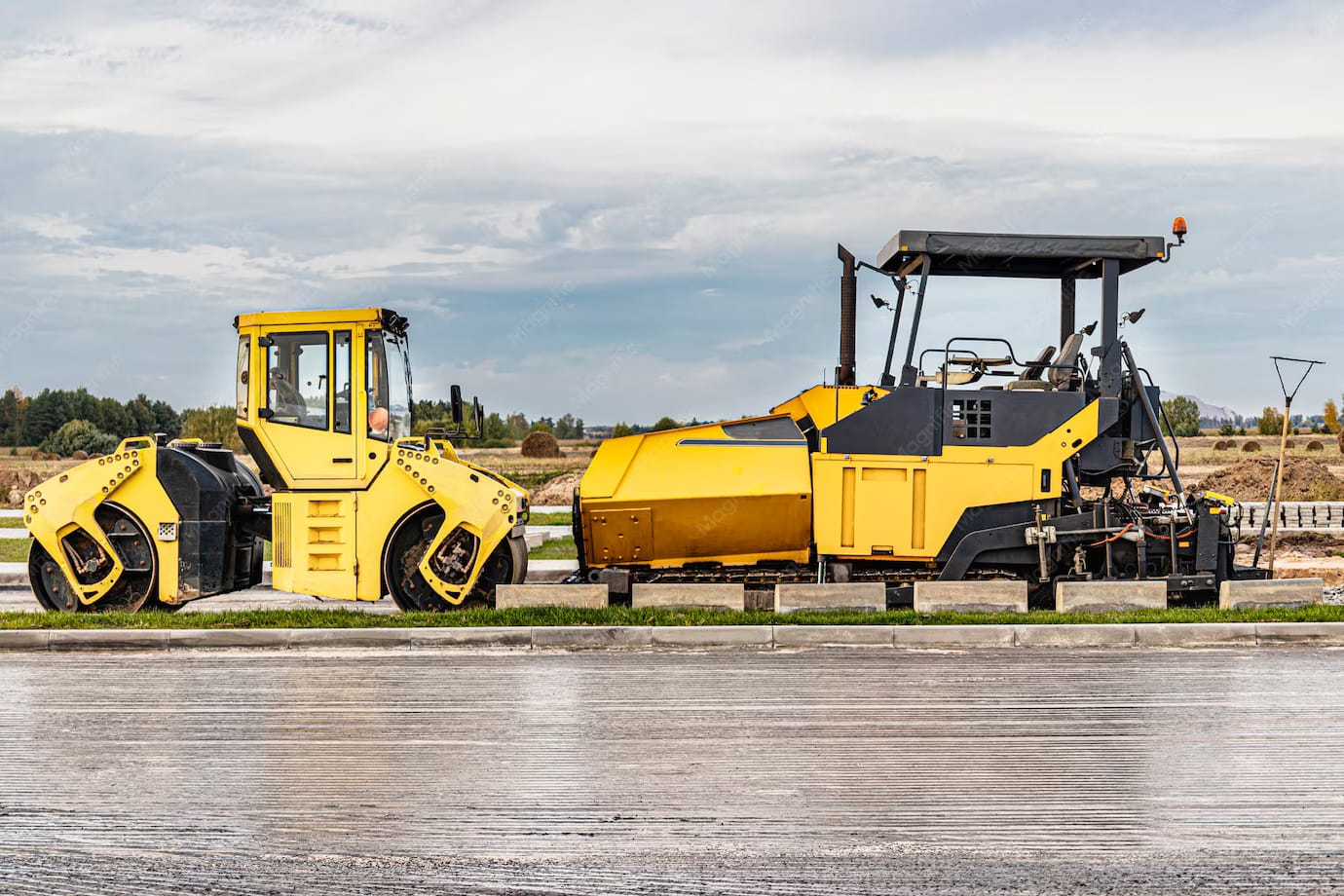
5. Asphalt placement and compaction: We place asphalt with commercial pavers, then compact it with vibratory and static rollers in a sequence that locks in density without shoving the mat. Joint construction is critical in industrial paving, so we pay close attention to butt joints at docks, curb lines, and tie-ins to concrete.
6. Detailing, markings, and quality checks: We install joint sealant at transitions where appropriate, adjust utility structures, and stripe truck lanes, loading zones, and safety markings. Density tests and final walkthroughs verify that the pavement matches the design intent and that drainage is functioning correctly.
Common Industrial Pavement Problems and How We Prevent Them
Industrial asphalt surfaces fail differently than retail parking lots. Heavy static loads, tight turning, and repetitive truck traffic produce rutting, shoving, block cracking, and base failures if the structure is not designed and built for those stresses.
In Charleston, we see rutting most often where trucks brake and accelerate at gatehouses and scale approaches. To counter this, Precision Asphalt Charleston adjusts the mix design to reduce binder content and improve aggregate interlock in those lanes, sometimes pairing asphalt with strategically placed concrete pads in the highest stress locations.
Drainage-related failures are also common. When water sits under heavy loads, it softens the subgrade and leads to alligator cracking and potholes. We design cross slopes and inlets to remove water quickly, and where needed, we add subdrains beneath heavy traffic lanes to intercept groundwater.
Interface issues are another problem area, especially at docks or where asphalt meets concrete. Poorly handled transitions create bumps, trip hazards, and stress concentrations. We use keyed or saw-cut joints, pay attention to elevations, and often reinforce these areas with thicker sections or full-depth patching.
For facilities that operate around the clock, we also factor in fuel and chemical exposure from loading operations. We may recommend sealers or surface treatments in specific areas to protect against diesel and oil softening the asphalt binder.
Project Planning, Permits, and Local Requirements
Industrial paving projects in Charleston often involve more than just the pavement itself. Depending on project size and drainage impact, you may need approvals from the City of Charleston, North Charleston, Charleston County, or nearby municipalities, as well as coordination with SCDOT if your access connects directly to a state-maintained road.
Precision Asphalt Charleston coordinates with local civil engineers and, when required, geotechnical firms to ensure your pavement plans align with any stormwater management or site development permits. If the work is part of a larger expansion or change of use, we can work from your engineer's drawings and provide constructability input on phasing, haul routes, and staging areas.
For port-related or bonded facilities, security and access requirements can significantly affect scheduling and phasing. We are accustomed to working within restricted access rules and can help you plan windows for high-impact work such as mill and overlay at main gates or inbound lanes.
If your site falls under strict environmental or industrial safety protocols, we collaborate with your EHS team to meet those requirements. That might include dust control, noise limits during certain hours, or special traffic control around hazardous material areas.
Cost Drivers and Options to Control Your Budget
The cost of industrial asphalt paving is driven primarily by three factors: required pavement thickness, subgrade correction, and operational constraints.
Thickness and mix type depend on your truck volumes, axle loads, and whether loads are moving or static. High-volume distribution centers and container yards typically need much thicker sections than light industrial flex space. During design, we can often tailor the section by zone, which prevents you from paying for heavy-duty thickness under light car traffic.
Subgrade conditions can add or reduce cost significantly. If the existing soil is firm and well-drained, we can often keep base thickness more economical. If we encounter saturated or organic soils, which are common in low-lying parts of the Charleston area, we may recommend undercut and replacement, or chemical stabilization. These steps increase upfront cost but typically save money versus repeated patching and downtime later.
Operational constraints, such as working only at night or in short shutdown windows, also influence pricing. We can provide alternate phasing scenarios that show how different schedules affect both cost and your productivity. In some cases, combining related work, such as drainage upgrades or concrete apron replacement, into the same mobilization helps control the overall budget.
Where appropriate, we may discuss phased improvements, such as reinforcing heavy truck lanes first, then addressing secondary areas later, so that the most critical portions of your pavement network are protected without requiring full-site reconstruction all at once.
Why Industrial Facilities Choose Precision Asphalt Charleston
Industrial and heavy-duty asphalt paving demands a contractor who understands both engineering and day-to-day operations. Precision Asphalt Charleston focuses on making your pavement reliable while minimizing disruptions to your business.
Our crews are experienced with live facilities, so we plan access routes, signage, and staging so that drivers, employees, and visitors know exactly where to go throughout the project. For many clients, we work during off-peak hours or weekends and sequence construction to keep shipping and receiving functional.
We track how industrial pavements we installed years ago are performing across the Charleston region, and we use that history to refine our designs. If we know that a certain mix has held up better at a local distribution yard with similar traffic, we incorporate that knowledge into your project.
When you contact us, we will not simply quote a square-foot price. Instead, we will review your site conditions, discuss your operational needs, and propose a pavement solution that balances long-term performance with realistic budget and schedule. The result is an industrial asphalt surface built to support your business, not just to pass inspection the day it is paved.